Madison Elite Cabinets specifies materials around one fact that most cabinet advice ignores: indoor air in a Wisconsin house swings harder than almost anywhere. January furnace heat can pull a house down to 20 percent relative humidity. July brings it back above 60. Every material in a kitchen has to live through that twice a year.
What the swing actually does
Wood takes on and gives up moisture with the air around it, and it changes dimension as it does. That movement is well documented and predictable. The problem is never movement itself, it is movement that the construction did not allow for.
A floating panel in a shaker door is designed to move and does so invisibly. A wide solid panel glued rigidly in place is not, and it splits or opens a joint.
Box materials, ranked
Plywood, best for most kitchens
Cross-laminated layers, so movement in one direction is restrained by the layer above. It holds screws well, tolerates the humidity swing, and if it gets wet it usually dries without falling apart.
This is what we use for carcases. The cost difference over particleboard is real but modest, and it is the single biggest durability decision in a kitchen.
MDF, excellent for painted doors
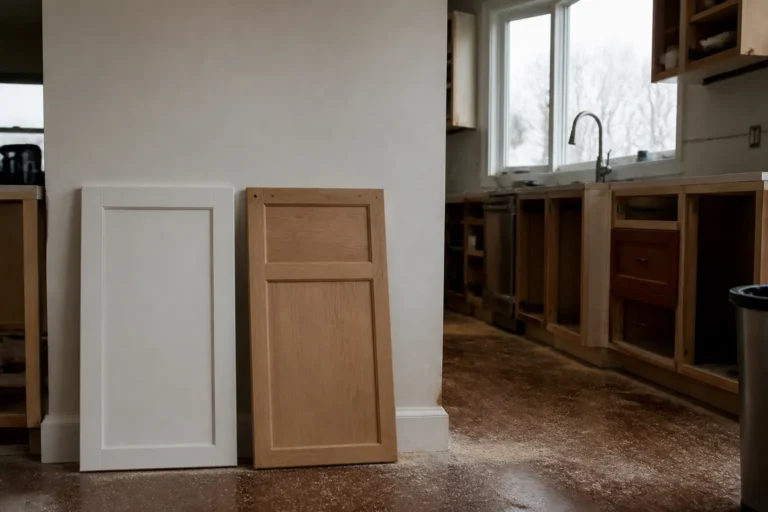
Dimensionally very stable and it takes paint beautifully, with no grain telegraphing through. That stability is exactly why most painted shaker doors use an MDF centre panel rather than solid wood.
Its weakness is water. MDF absorbs like a sponge once the finish is breached, and it does not recover. Fine for doors, wrong for a sink base floor.
Particleboard, avoid where water reaches
The default in inexpensive cabinets. One slow supply-line weep under a sink and the bottom swells, crumbles and stays that way. Most cabinet failures we are called to replace start here.
Solid wood, for frames and doors
Right for face frames, door rails and stiles, where its strength matters and its movement is accommodated. Wrong for wide flat panels in this climate unless the design lets them float.
Species that suit the climate
Maple and birch are stable, take paint and stain evenly and are locally available, which matters for both cost and matching. Oak is stable and its open grain hides small marks well, though it reads traditional. Hickory is very hard and moves a little more. Cherry darkens noticeably over the first year, which is either the appeal or a surprise.
Thermofoil
The wrapped vinyl film on inexpensive white doors is heat-activated in manufacturing, and heat releases it. Near a dishwasher vent or an oven it lifts, and once it starts there is no repair. We do not recommend it.
Finish matters as much as material
A catalysed conversion varnish resists moisture far better than a standard lacquer, and it is what we spray. Just as important is coverage: all six faces, including backs, undersides and shelf edges. An unsealed edge is where moisture enters.
On stained doors, expect a hairline of unstained wood to appear at the edge of a floating panel in midwinter and close again by June. That is normal and not a defect. It is also one more argument for paint on five-piece doors if it would bother you.
Room by room
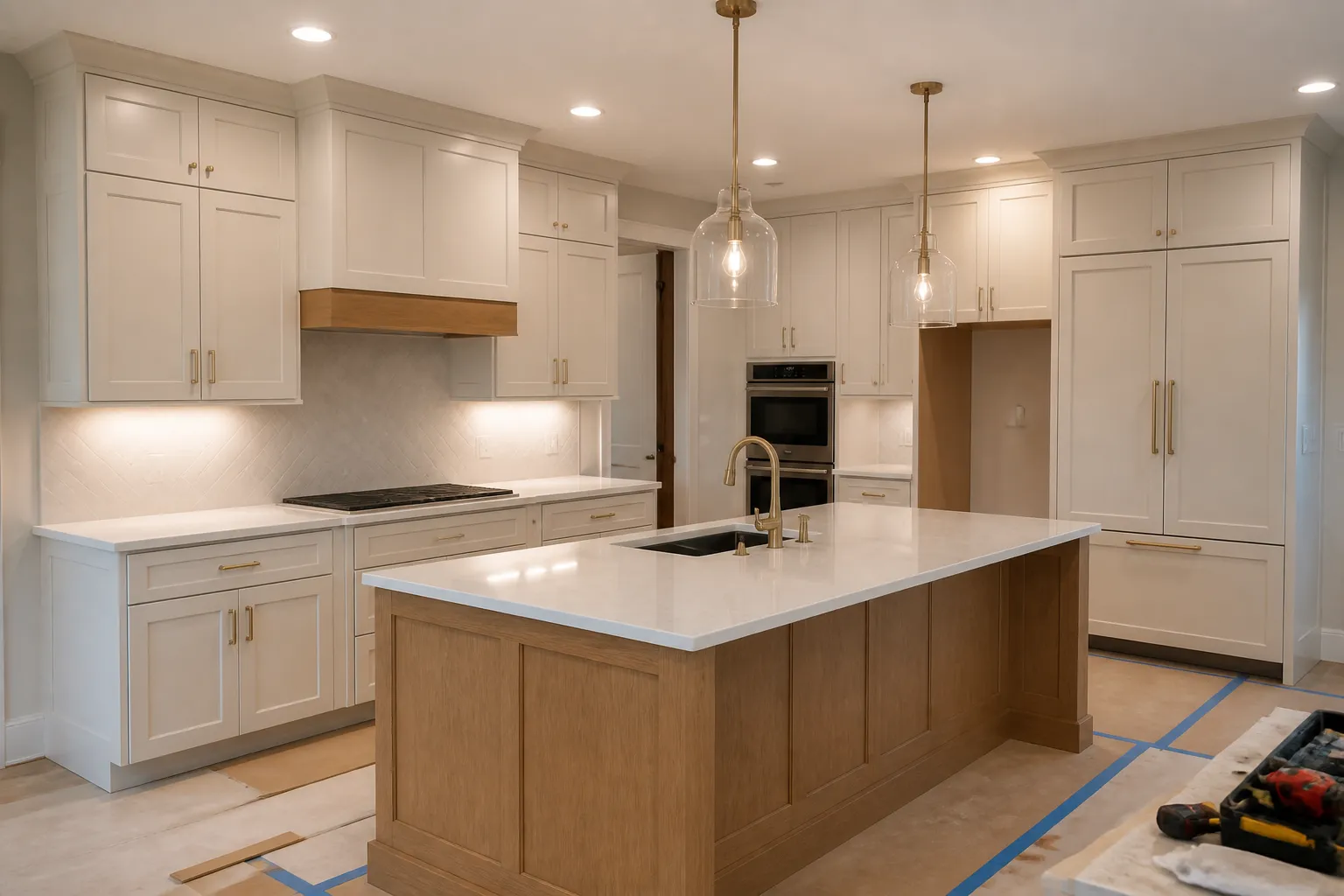
Kitchen. Plywood boxes, MDF or solid door panels, catalysed finish. The sink base deserves particular attention and a drip tray.
Bathroom. Same as kitchen, with more care at floor level. See bathroom cabinets.
Basement or laundry. Plywood only, kept off the slab, every face finished. Humidity is higher than people think even when the floor feels dry.
Garage. A different problem entirely. Road salt and freeze-thaw rule out most residential materials. Our garage cabinets page covers what survives.
Outdoors. Nothing residential survives. See outdoor cabinets.
If your existing boxes are sound
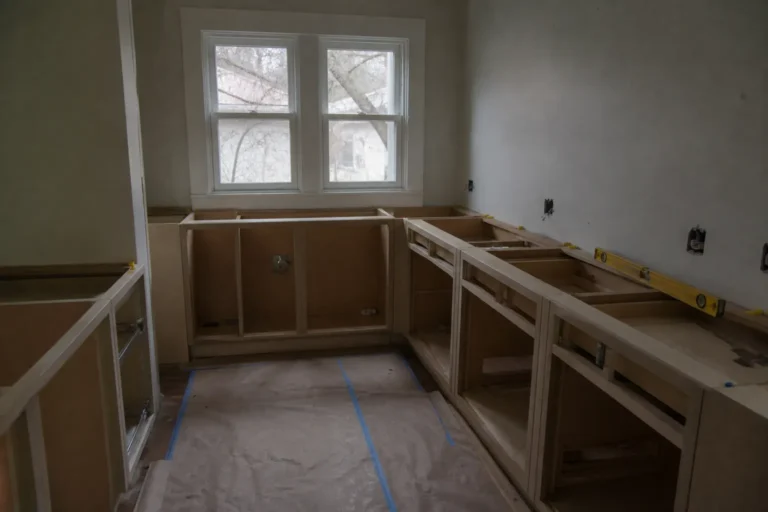
Material choice only matters for what you are replacing. If the carcases are plywood and square, new doors and a new finish transform the kitchen for far less. Refinishing keeps the wood grain, painting covers it.
If indoor air quality matters to you, the EPA formaldehyde emission standards for composite wood under TSCA Title VI set the limits for the plywood, MDF and particleboard sold in the US.
Common questions
Is plywood always worth the upgrade over particleboard?
For carcases, yes, especially anywhere near water. It is the cheapest insurance in the whole project.
Will solid wood doors crack in a dry Wisconsin winter?
Not if they are built as floating panels. Rigidly glued wide panels are the ones at risk.
Does a humidifier help?
Keeping indoor humidity in a moderate band year-round reduces movement in everything wooden, cabinets and floors alike. Consistency matters more than any particular number.
Is MDF a cheap material?
Not inherently. For painted doors it outperforms solid wood on stability. It is only a problem where water reaches it.
What about bamboo or engineered alternatives?
Some perform well. Ask specifically how the manufacturer handles moisture and whether all faces are sealed.
How do I start?
Open the cabinet under your sink and look at the bottom panel. That one look tells us most of what we need to know.
Specify for the climate you have
We build for Wisconsin humidity rather than adapting a mild-climate specification. Call (608) 665-1379.