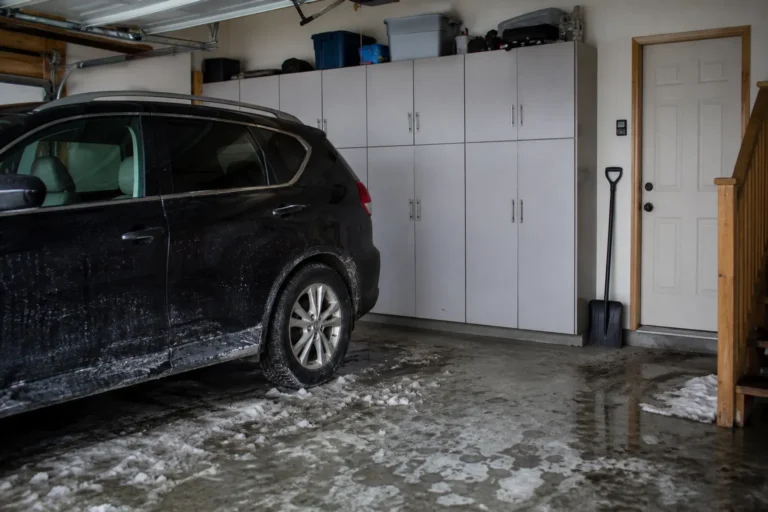
Madison Elite Cabinets designs, builds and installs custom cabinets for homeowners across Madison, WI. Most mudroom designs are drawn for a mild climate — a bench, some hooks, a few cubbies. Then a Wisconsin February arrives and it turns out the family needs somewhere to put four pairs of soaked boots, two snow-covered jackets, gloves that need to dry by tomorrow morning, and a shovel.
The gap between those two pictures is the whole design problem.
Design for wet, not just for storage
The defining feature of a Wisconsin mudroom is that everything coming into it is wet, and much of it is carrying road salt. Storage that assumes dry items will fail.
Airflow beats enclosure
Closed lockers look tidy and trap moisture. A wet jacket in a sealed cubby is still wet the next morning and starts to smell by March. Open lockers, slatted shelves, or louvered doors let air move.
If you want doors for the sake of a tidy look, put them on the seasonal storage and leave the daily-use bays open.
Give boots a drainable home
A boot tray, a slatted shelf over a waterproof pan, or a recessed area with a tiled and sloped floor. The goal is that meltwater and salt end up somewhere you can wipe rather than soaking into a cabinet bottom.
The cabinet bottoms nearest the floor should be a waterproof material or a raised, finished panel — not raw particleboard, which is what fails first in every mudroom we are called to repair.
Plan a drying zone
A short hanging rod above the boot area, or a couple of hooks with 18 inches of clear space below them, does more good than six more hooks in a row. Gloves and hats dry fastest on a rack or a shallow wire basket rather than in a bin.
Dimensions that work
- Bench height: 17 to 18 inches. Lower than a chair, because people sit to pull boots off.
- Bench depth: 16 to 18 inches.
- Locker bay width: 12 to 15 inches per person. Wider feels generous and encourages piling.
- Hook height: 48 inches for children, 66 inches for adults. Two rows is better than a compromise height.
- Upper cabinet: start at about 68 inches so coats can hang below.
- Clearance in front: 36 inches minimum, and more if it is also the route from the garage to the kitchen carrying groceries.
Where it goes when there is no mudroom
Plenty of Madison homes — particularly older ones — have no dedicated mudroom, just a back door into a kitchen or a stair landing. Options that work:
- A shallow built-in along the stair wall. Twelve inches of depth with hooks and a narrow bench handles a surprising amount.
- Converting a coat closet. Removing the door and fitting it out as an open locker usually doubles its usefulness.
- The garage side of the door. Boots and outerwear stay out of the house entirely, which some households prefer.
A built-in sized to the actual wall almost always outperforms a freestanding bench in these spots, because the wall is rarely a standard width.
Materials and finish
Painted MDF or plywood with a catalysed finish handles the wet-dry cycling. Avoid open-grain stained wood at the floor level — road salt leaves white deposits that are difficult to remove from an open grain.
Use a satin or semi-gloss rather than matte. It wipes clean, and a mudroom gets wiped often. A darker colour on the lower cabinets and bench hides scuffs from boots better than white.
For hooks and rods, stainless or a quality finish — plated hardware corrodes where salty gloves hang on it.
Flooring and the edge detail
Tile or luxury vinyl with a proper transition, and a real baseboard detail where the cabinetry meets the floor. The failure point is almost always the joint between the cabinet toe kick and the floor: water sits in it. A tiled toe kick, or a cabinet raised on a waterproof base with a caulked joint, solves it.
Seasonal rotation is part of the design
A Wisconsin household has two complete outerwear wardrobes. Building in a high cabinet or a deep top shelf for the off-season set keeps the daily-use bays from overflowing. Households that skip this end up with summer sandals competing with snow boots for the same shelf in January.
If the mudroom is genuinely too small, moving the off-season storage into custom closets elsewhere in the house is the better answer than cramming.
Frequently asked questions
How much space does a mudroom need?
Six linear feet of wall handles a family of four reasonably. Under four feet, prioritise hooks and boot space over a bench.
Should lockers have doors?
For daily winter gear, no — airflow matters more. For sports equipment and seasonal storage, yes.
Is heated flooring worth it in a mudroom?
It is one of the better places for it in a Wisconsin house. It dries the floor and it is the first surface you step onto.
Can a mudroom bench have storage under it?
Yes, but leave the boot zone open. Drawers under a bench work well for gloves and hats; a lift-up lid gets used less than people expect.
Plan it for February
We design entry storage around the worst week of the year rather than the easiest. Call (608) 665-1379 for a free consultation.