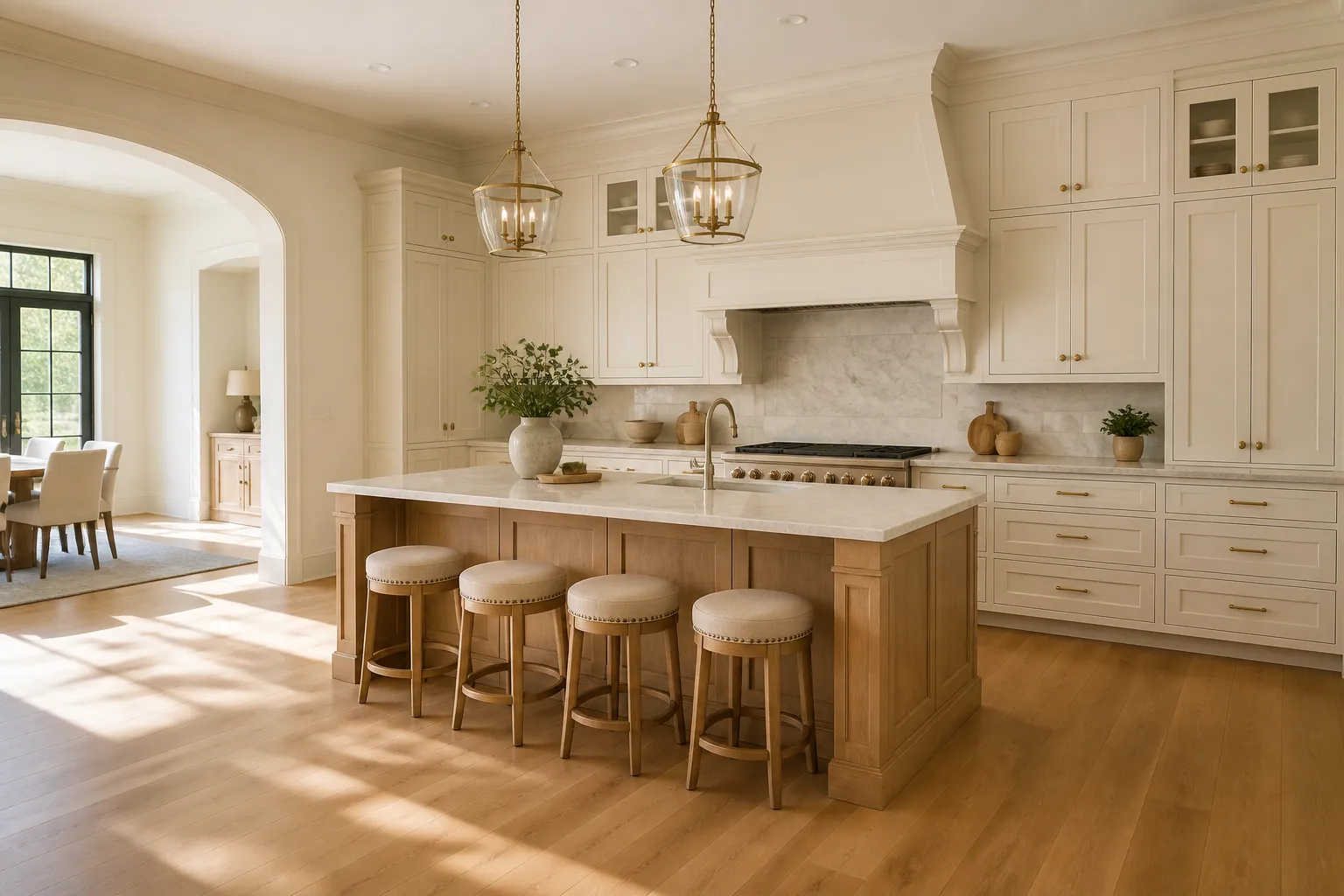
Madison Elite Cabinets designs, builds and installs custom cabinets for homeowners across Madison, WI. People use “refinishing” and “painting” as if they were the same job. They are not. Refinishing strips or scuffs the existing finish and puts a new clear or stained finish back on, keeping the wood grain visible. Painting covers the grain entirely with an opaque coating.
Which one is right depends on what your doors are made of, what you want the kitchen to look like, and — more than people expect in Wisconsin — what time of year the work happens.
Refinishing
Refinishing suits solid hardwood doors: oak, maple, cherry, hickory. Madison has a lot of them, particularly in homes from the 1980s and 1990s and in the older bungalows and four-squares on the near east and west sides.
What it can and cannot change
You can go darker easily, lighter with difficulty, and you can change the sheen from a dated high gloss to a modern satin. You cannot make oak stop looking like oak — the open grain shows through any stain.
What refinishing does exceptionally well is rescue doors that are structurally perfect but look tired: worn finish around the handles, a cloudy or ambered clear coat, water marks near the sink. Our cabinet refinishing work is usually on doors that have another thirty years in them.
Where it goes wrong
Veneer doors. If the face is a thin veneer over particleboard, aggressive sanding goes through it and the repair is a new door. A test spot in an inconspicuous corner settles this before any work starts.
Painting
Painting works on far more door types — solid wood, paintable MDF, and previously painted surfaces. It is the only realistic route to a white, grey or deep green kitchen from an oak starting point.
Grain telegraphing
Painted oak still shows its grain texture through the paint. Some people like it, some are surprised by it. Filling the grain first with a grain filler or a high-build primer eliminates it, at the cost of extra labour and a couple more days.
Ask to see a painted oak sample in person before committing. It is the number one source of disappointment in cabinet painting projects.
Thermofoil
Doors wrapped in a white vinyl film do not accept paint reliably, and once the film has started lifting anywhere, painting will not save them. Those are replacement or refacing candidates.
What Wisconsin’s seasons do to the job
Winter
Heated indoor air in January can drop to 20 percent relative humidity or below. Finishes cure differently in dry air — often faster on the surface than underneath, which can trap solvent and leave a soft film that marks easily for weeks.
Wood also shrinks. On a stained shaker door, a hairline of unstained wood can appear at the edge of the floating centre panel in midwinter and disappear by June. That is normal on stain-grade work and is one more argument for paint on five-piece doors.
Summer
Madison summers run humid. Finishes cure more slowly, and doors stacked before they have fully hardened will print against each other. A reputable shop builds in cure time rather than rushing to rehang.
The practical takeaway
Spring and fall are the easiest windows. Winter work is fine when the doors are sprayed in a controlled shop environment rather than a cold garage — which is the real question to ask about anyone’s process.
Cost and timeline, roughly
Both jobs are labour, not materials. Refinishing typically costs a bit more than painting on the same kitchen because stripping is slower than scuffing. Either one is a fraction of replacement, and both run in the range of three to seven working days depending on door count and whether the work is on site or in a shop.
If the boxes themselves are failing, neither is the right spend — refacing or replacement is.
How to decide in five minutes
- Are the doors solid wood? If no → painting or refacing.
- Do you want to keep visible wood grain? If yes → refinishing.
- Do you want white or a colour? → painting.
- Do you mind seeing oak grain texture through paint? If yes → budget for grain filling.
- Are the boxes sound? If no → neither; look at replacement.
Frequently asked questions
How long does a refinished or painted kitchen last?
A properly prepared and sprayed finish holds up ten to fifteen years in normal use. The areas that wear first are around handles and above the dishwasher.
Can you match new cabinets to refinished old ones?
Close, rarely exact. Wood from different lots takes stain differently. Matching paint is straightforward; matching stain across old and new wood is not.
Do I have to move out of the kitchen?
Not usually. Doors come off, the boxes stay. Expect a few days of open shelving and dust containment.
Is spraying better than brushing?
For cabinets, yes. Spraying gives a level film with no brush texture. Brushing is acceptable on interiors and frames where the finish is barely seen.
Have the doors looked at
A ten-minute look tells us whether your doors are solid wood, veneer or thermofoil — which decides everything else. Call (608) 665-1379 for a free consultation.